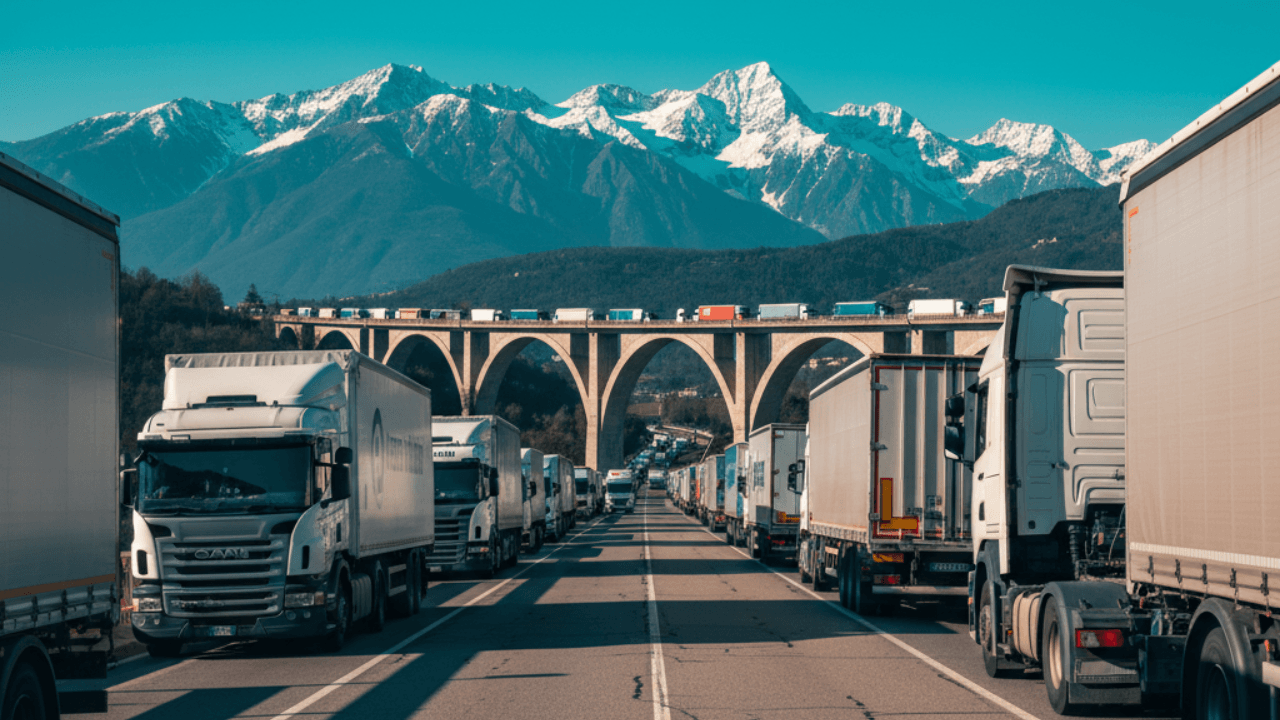
A Freight Eldorado with an Achilles' heel: How to manage the paradox of the Italian Market

| DOWNLOAD FOR FREE |
Veritable boom by Italianoo
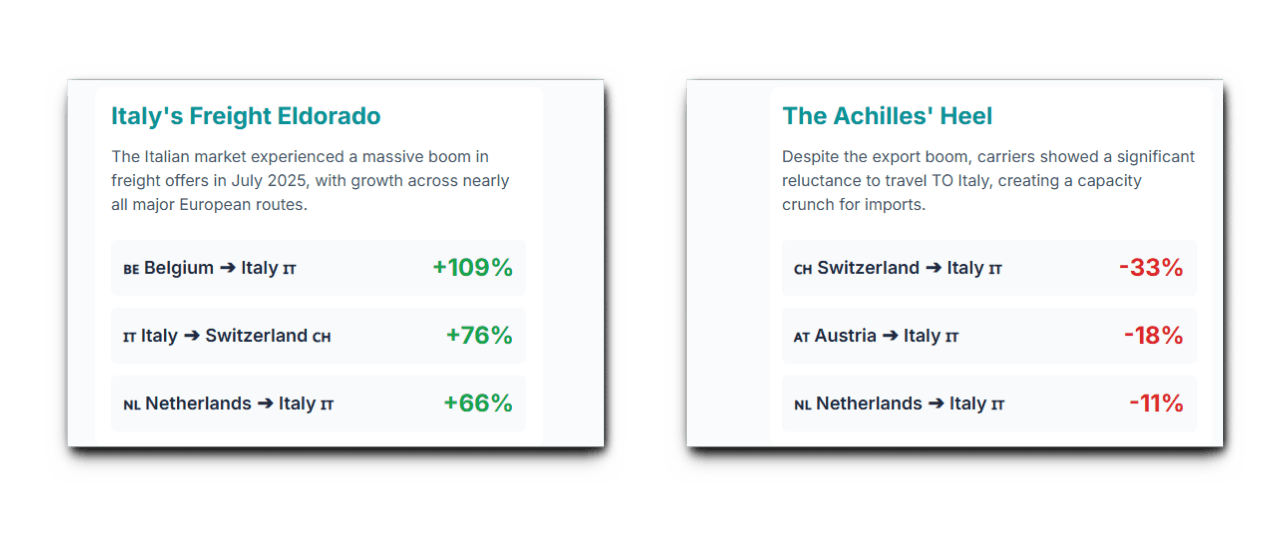
The data flowing from the Italian transport market can be staggering. From every angle, we are receiving signals of a massive recovery. The "Transport in Europe" report calls the situation in no uncertain terms a "freight eldorado." And this is no exaggeration.
This paints a picture of a market teeming with opportunities, where there are more goods to ship than ever before.
"Freight transport in Italy is undergoing a noticeable transformation, with the latest data showing a mixed situation on European routes. [...] Export traffic from Italy remains strong, especially towards France, Spain, and Germany, driven by the healthy state of exports. Conversely, import traffic appears weaker, indicating a temporary imbalance in trade flows" – confirmed by Nicolò Berghinz of ALIS - the Association for Sustainable Intermodal Logistics.
And it is in this last sentence that the crux of this abundance dilemma lies. What good is a record number of shipments if finding a truck to pick them up becomes nearly impossible? Beneath the surface of this eldorado lurks a structural problem that can paralyze even the most prosperous businesses: a chronic lack of transport capacity.
La Grande Fuga: Why are Carriers avoiding Italy?
The problem with the Italian market can be summed up in a single sentence, stated directly in the report: while finding transport out of Italy is no problem, "carriers are far less interested in driving to Italy." This phenomenon, which could be called "La Grande Fuga", is the greatest strategic challenge for Italian shippers. The data leaves no room for doubt – we are observing a steady and consistent decline in carriers' interest in handling transport to Italy.
-
Carrier activity on routes to Italy from the Netherlands, Belgium, and Switzerland declined steadily for three consecutive months, from May to July.
-
On the route from Switzerland to Italy, the drop in load searches in July marked the fifth consecutive month of decline.
-
The situation is little better on the key route from Poland to Italy, where only one month in 2025 saw an increase in interest from carriers.
Why is this happening?
This is not a fleeting anomaly, but a deep, structural crisis.
"The Italian freight transport market is facing structural pressure: the demand for transport services is growing, but the available 'capacity' is shrinking due to a deepening driver shortage and the fleet reductions by many Eastern European carriers. On several export routes, especially to France, Germany, and Spain, an increase in spot activity is observed, driven by a scarcity of domestic transport resources. [...] Overall, the number of searches from Italy is growing faster than to Italy, confirming the imbalance in flows and available capacity" – diagnosed by Stefano Codognotto, executive director at Codognotto Italia S.p.A.
When calculating a route, a carrier fears one thing above all: an empty backhaul. The trade imbalance makes entering Italy a significant business risk for them. That risk comes at a price.
Turning a oroblem into a competitive advantage
This fundamental imbalance between supply and demand has a direct and painful impact on freight rates, which are rising at a breakneck pace.
This is the price of admission for access to dwindling resources.
-
On the Italy -> France route, rates in July increased by +22.8% year-on-year.
-
On the Italy -> Slovenia lane, the increase was even more spectacular, reaching +34.1%.
-
Overall in June, all 18 analysed Italian routes recorded a year-on-year rate increase.
In this situation, competing solely on price in the spot market is a one-way ticket to disaster. The winners will not be those who find the cheapest single offer, but those who systematically solve the carrier's problem. The key to success for Italian companies is to become a "shipper of choice"—a partner who offers more than just an export load.
How can this be achieved?
-
Build strategic partnerships: Instead of treating a carrier like a service provider, start seeing them as a key partner. Long-term contracts, volume guarantees, and transparent communication build trust.
-
Offer solutions for empty runs: Actively collaborate with your import and purchasing departments to provide carriers with return loads. Consider offering round trips or partnering with other local companies to consolidate import freight.
-
Optimize warehouse operations: Time is money, especially for a driver. Guaranteeing fast and efficient loading, flexible time windows, and minimizing downtime is a powerful bargaining chip that can make your company far more attractive than the competition.
Companies that understand they must actively manage the "empty-run-into-Italy" problem will gain virtually unlimited access to transport capacity. At a time when the ability to ship goods on schedule is becoming a key competitive advantage, such a strategy will allow them not only to survive but to dominate the market.
Key Takeaways for Leaders:
-
Embrace the paradox: The immense demand for your goods is coupled with a transport availability crisis. Focus on managing the latter.
-
Think like a Carrier: Their biggest barrier is the risk of an empty run into Italy. Your job is to help them minimize that risk.
-
Shift your Collaboration Model: Move from the transactional hunt for the lowest price to strategically building partnerships that guarantee stability and access to capacity.
-
Invest in Operational Efficiency: Fast loading and well-organized warehouse operations are powerful arguments when negotiating with transport companies.
| DOWNLOAD FOR FREE |
Main graphic source: Google, Imagen AI Generated.