
French Armageddon: How to survive and gain market share at the epicenter of the transport crisis

The data is unforgiving and confirms what many managers are experiencing day-to-day: we are at the epicenter of the European crisis. Only the strongest, most flexible, and those who can make strategic decisions based on hard data, not sentiment, will survive.
| DOWNLOAD FOR FREE |
Facing the truth is the first step toward building a strategy for survival and, more importantly, for expansion.
The scale of the problem is immense:
-
The epicenter of the bankruptcy wave: The bankruptcy declaration index in the French TSL sector reached an astronomical level of 288 points in the second quarter of 2025. For comparison, the average for the entire European Union was 178.7 points. This means the number of bankruptcies is nearly three times higher than in the 2021 baseline year.
-
A brake on new initiatives: Simultaneously, France is the only country in the analysis where fewer new transport companies are being registered than in 2021.
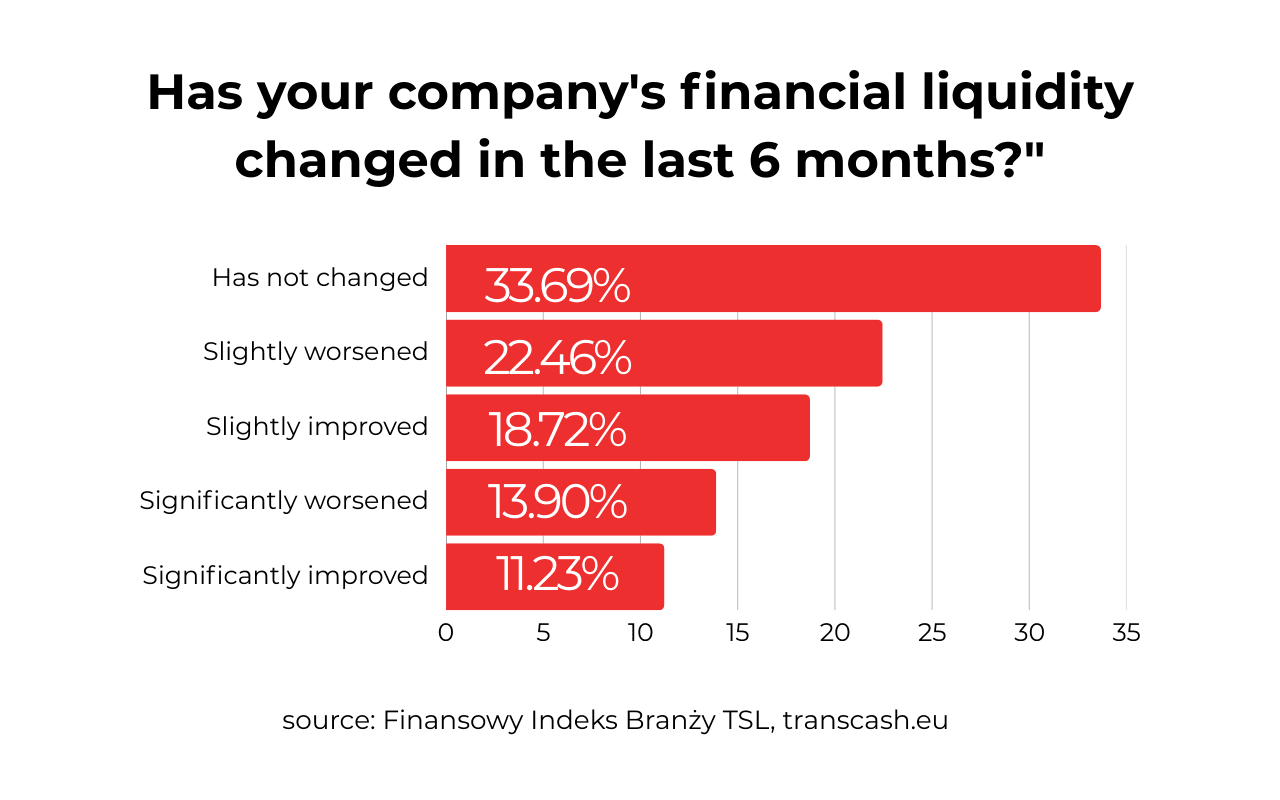
This crisis is not accidental. It has deep, structural causes.
"The case of France, where the bankruptcy index is rising most sharply and the new company registration index is the weakest, is not surprising. On bilateral routes from this country, the share of French carriers is small. [...] Additionally, French companies are not helped by their economic system—over-regulated, full of extensive social privileges, and with the shortest working week in Europe” – diagnosed by Maciej Wroński, president of Transport and Logistics Poland (TLP)
It might seem like a no-win situation.
But even in the greatest chaos, there are constant, predictable patterns. The key is to identify and leverage them.
Imbalance as the only constant: The dynamics of flows with the Benelux countries
In an unstable environment, a strategic advantage is built on what is predictable. And for the French logistics market, the most predictable phenomenon is the fundamental imbalance of trade flows, especially with the Benelux countries.
Data from the report shows this with surgical precision:
-
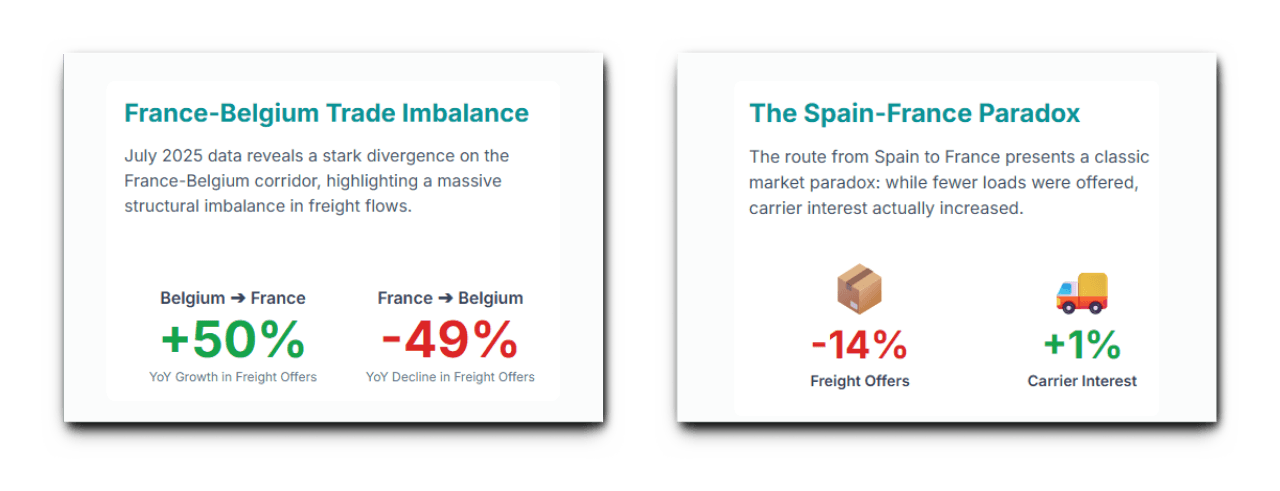
Collapsing exports: On the France -> Belgium route, volumes have remained very low for several months. July was the fourth consecutive month of decline, and the number of freight offers was a full 49% lower than the previous year.
-
A deluge of imports: At the same time, demand on the Belgium -> France route is gigantic. In July, the number of cargo offers was 50% higher than a year ago.
This extreme asymmetry is not an anomaly – it is an iron rule of the market that must be understood and integrated into your strategy.
"There is a traditional imbalance of flows between Belgium and France: imports into France significantly exceed exports. This imbalance stems from the massive influx of goods imported through Northern European ports, especially Belgium's. France consumes more finished and semi-finished products than it produces, resulting in a large trade deficit. As the economy shrinks [...], exports have fallen further" – explains Stéphanie Jousse, freight director at Ziegler France.
Understanding this dynamic is the first step to mastering the chaos. Instead of fighting for scarce and low-margin export loads, smart companies are focusing their energy on securing and flawlessly servicing strategic import corridors.
A strategy for survival and expansion
In an environment where competitors are disappearing from the market en masse, the most valuable currencies become stability and reliability. Clients, weary of uncertainty and delivery problems with their previous partners, are actively seeking a safe haven. This is your chance.
The demand for transport to France remains powerful, confirmed not only by data from Belgium but also from Germany. On the key Germany -> France route, the number of cargo offers in July was 46% higher than the previous year. Clients desperately need to move their goods, and the carrier market is shrinking.
The strategy for French companies must be built on two pillars: survival and seizing a historic opportunity to capture market share.
The conclusion is simple: The key is to secure transport capacity on strategic import corridors (primarily from Belgium and Germany) while simultaneously building a reputation as an absolutely dependable partner. At a time when news of another company's collapse is a regular occurrence, such a reputation is priceless. It allows you not only to retain existing clients but to actively acquire those who have been abandoned by the competition.
This is not a time for price wars.
This is a time for building a fortress based on quality, punctuality, and partnership. When the dust settles, the only ones left standing will be those who, in the most difficult moments, were able to deliver not just goods, but above all – certainty and peace of mind.
Key takeaways for leaders:
-
Accept the reality: The market is undergoing a brutal shakeout. Weak players will disappear—creating a vacuum for you to fill.
-
Focus on what matters: Don't waste energy fighting for unprofitable export loads. Dominate the key import corridors from Belgium and Germany, where demand is immense.
-
Reliability is your new marketing strategy: In a crisis, clients aren't looking for the cheapest offer, but the safest one. Every on-time delivery builds your brand more powerfully than any advertisement.
-
Be ready to acquire: Monitor the market and be prepared to offer stable cooperation to clients whose previous partners are disappearing. This is a historic opportunity to gain market share.
This article is based on "Transport in Europe. Trends. Data. Analysis" report.
| DOWNLOAD OUR REPORT HERE FOR FREE |
Main graphic source: Google, Imagen AI Generated.