
Logistics in times of paradox: how megatrends collide with the transport market in 2025

If you feel that traditional models no longer work, you are right. What we are experiencing is not a temporary anomaly. It is a powerful collision of long-term megatrends with brutal operational reality. Do you remember our article on megatrends for 2025-2035? [Click here to read it!]
Today, we see them in action. Live. The crisis in carrier profitability and shrinking transport capacity are becoming the new, solid foundation of the market.
And we are not alone in this. Industry practitioners confirm this.
I believe that we are on a slippery slope, which is bound to result in a much deeper crisis in the industry. Falling volumes and shrinking transport capacity are temporarily balancing the market situation. However, it should be remembered that companies cannot continue to operate at a loss indefinitely. [...] I expect a severe shortage of transport capacity and a significant increase in rates in the coming months," – comments dr Paweł Trębicki, managing director, Rhenus Road Freight - Central East Region (in the report ”Transport in Europe").
For SMEs, the main advice is to start counting. Consider the profitability of the orders you carry out. For larger companies, be patient, don't give in to the mood, wait out the difficult times," comments Maciej Wroński, president, Transport i Logistyka Polska (in the report ”Transport in Europe").
The Italian freight transport market is facing structural pressure: demand for transport services is growing, but available capacity is declining due to a growing shortage of drivers and fleet reductions by many carriers from Eastern Europe. Rates are rising across the sector, not only because of inflation, but also as a correction after years of underestimated transport," comments Stefano Codognotto, executive director, Codognotto Italia S.p.A. (in the report ”Transport in Europe").
“World Wars” in practice
The infuture.institute Trend Map clearly shows that we are living in a “World of Wars,” with phenomena such as Deglobalization and Inflation at the very center of the present (in the “NOW” circle).
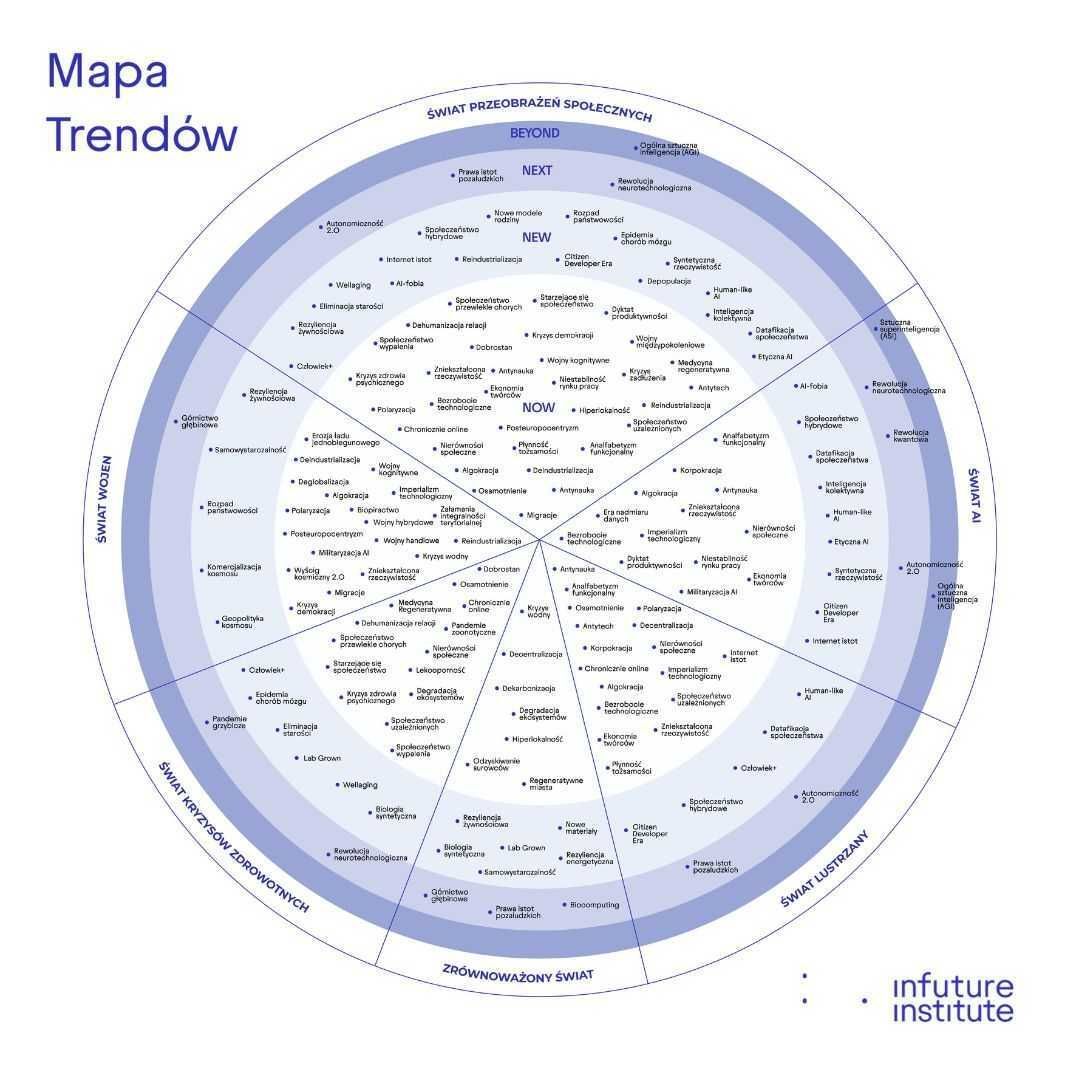
These forces are no longer abstract, but a concrete challenge that we see around the world. The vulnerability of global supply chains to disruption has been highlighted by issues such as the crisis in maritime transport in the Red Sea and shortages in the semiconductor market, as indicated by an analysis by freightify.com.
We can also see this in the data from the latest report “Transport in Europe. Trends. Data. Analysis”.
On the one hand, global supply chains are still functioning – the report confirms that ports in Belgium and the Netherlands are the main “cargo hubs in Europe,” which directly affects the activities of Belgian transport and forwarding companies. On the other hand, however, the local resilience of the entire ecosystem is collapsing.
The increased pressure is particularly reflected in the costs of container transport [...] Companies are now better prepared for shocks in their supply chains … instability of supply chains has forced many changes in their companies in recent years” – Rolf Bos, PwC Netherlands.
The declared bankruptcy rate in the TSL sector in the second quarter of 2025 reached 178.7 points in the EU, which means that the number of bankruptcies is nearly 80% higher than in the base year of 2021. Companies simply do not have the financial cushion to survive this period of turmoil.
The fragile resilience of supply chains
On top of that, there are geopolitical shifts. As a manager in Hungary or Belgium, you will see how the competitive landscape is changing.
Experts in the report point out that Polish carriers are losing ground in the West to cheaper companies from Romania, Lithuania, and Ukraine. This means that your competitors are no longer just across the Oder River, but also beyond the Carpathian Mountains, and pressure on rates and margins is growing from completely new directions.
In order to save their profitability, carriers are deciding to change the routes they serve to alternative ones with lower road tolls or cheaper fuel [...]. Polish carriers are being replaced by Romanian, Lithuanian, and Eastern European carriers, whose labor costs are often nearly half those in Poland,“ comments Natalia Foszt, business development director at Omida VLS (in the report ”Transport in Europe").
The recession in key economies such as Germany and Italy is a serious warning sign for the TSL industry. [...] For carriers, especially those heavily dependent on these countries, diversification is becoming a key survival strategy,“ comments Radosław Lemieszek, Director of Warehouse Logistics and Contract Fleet, MCG Logistics (in the report ”Transport in Europe").
I see two aspects to the decline in export routes: Polish carriers are more expensive than Ukrainian carriers, and Western companies are focusing on reducing costs, even overlooking the aspect of freight security and transport monitoring," comments Dr. Adam Koliński, professor at the University of Logistics (in the report ”Transport in Europe").
Furthermore, in Carbon Brief, Prof. Jason Bordoff warns that today's international conflicts pose a serious risk—not only do they complicate, but also delay the energy transition, which may lead to growing problems.
Sustainable development: regulatory necessity versus cost reality
The megatrend of a “sustainable world” is a strategic necessity from which there is no turning back. Analyses by T&E, cited in The Guardian, indicate that if current policies continue to lead to slower decarbonization of transport compared to the energy and industrial sectors, emissions from transport could account for 44% of the continent's total emissions by 2030.
However, market data from 2025 shows that for most transport companies, this is primarily a growing burden today.
Today, we're in a world where some of the geopolitical risks, like conflict and economic fragmentation, are making the transition harder. If we're not careful about how we go about this transition, it can actually make some of those geopolitical problems worse” – Jason Bordoff, Founding director, Center on Global Energy Policy at Columbia University’s School of International and Public Affairs (World Economic Forum)
Because ‘there are many different pathways to net zero,’ the path that is chosen will, in turn, affect geopolitics ... How this is done is going to have a huge impact on global affairs” – Meghan O’Sullivan, director Energy Project (harvardmagazine.com)
The transition is slow and costly. The data from our new report is clear: in Poland, as much as 99% of newly registered vehicles still run on diesel. And this is unlikely to change, given the geopolitical turmoil and the EU's drive for competitiveness between the US and China.
However, experts clearly indicate that the costs associated with the “green deal” and the Mobility Package are among the main factors that are killing profitability and leading to fleet reductions.
The conclusion is painful but true: for transport companies in 2025, sustainability is primarily a growing operating cost and regulatory requirement, rather than a market opportunity. This exacerbates the crisis and causes investments in the green transition to be postponed.
Carriers usually anticipate price increases and make purchases even before new regulations requiring additional equipment are implemented. [...] The latest CO2 emission standards and changes to the Eurovignette system may have created uncertainty among carriers, prompting them to postpone investments,“ comments Romain Mouton, senior research manager, IRU (in the report ”Transport in Europe").
As for the registration of zero- and low-emission vehicles, the truth is that no country is coping with decarbonization. The statistics provided by various associations concern the registration of new vehicles – electric vehicles account for barely a fraction of a percent of the entire European fleet,“ comments Maciej Wroński, president, Transport and Logistics Poland (in the report ”Transport in Europe").
Download our report on decarbonization from the perspective of polish carriers: HERE
Recommendations for Transport & Logistics for now!
The analysis of data and trends is not intended to scare you, but to help you build an informed strategy.
So what can you do in this situation to not only survive, but also emerge from this chaos stronger than ever?
Move #1: Radical selection and diversification of markets
Not every market in Europe is suffering equally. “Transport in Europe. Trends. Data. Analysis” report divides countries into three groups:
1) pessimistic (Germany, France), 2) neutral (Italy, Poland, Belgium) and 3) optimistic (Spain).
Spain is the only country that stands out with positive economic and industrial sentiment indicators.
-
Escape stagnation: Check how dependent your company is on Germany's weakening economy. Maybe it's time to actively shift some of your resources to the more promising markets of southern Europe? As experts advise, “diversification is becoming a key survival strategy.”
-
Play the “highways”: Focus on the main, profitable corridors where volumes are stable and finding return loads is easier. Avoid peripheral, unstable routes that generate empty runs and eat into your margins.
Move #2: Preparing for the new wave of technology
The infuture.institute Trend Map places “Autonomous Logistics” and “Cognitive Robotics” in the “NEW” horizon (1-5 years). The severe staffing crisis and driver shortage mentioned by experts in the report will only accelerate this revolution.
-
Invest in data when there is a shortage of fleet: New truck registrations in Europe are falling sharply (by 27.5% y/y in Germany). With investments in equipment on hold, it is crucial to make the most of current resources. This is the perfect time to implement advanced analytics and telematics systems to increase efficiency here and now, while preparing your company for the technologies of tomorrow.
Move #3: Building flexibility into your business model
The old rules no longer apply. Stability no longer lies in rigid contracts, but in the ability to adapt.
-
From contracts to SPOT: The market is clearly drifting towards spot transactions. As one expert notes, “contracts no longer guarantee that customer needs will actually be met” when rates become unprofitable. Companies must learn to manage this volatility, e.g., through shorter contracts with flexible clauses.
-
From transport to services: Look for profitability in higher value-added services – warehousing, freight forwarding, contract logistics, or specialized transport, rather than just “bare” freight.
Those who understand the paradox will survive
The current crisis is a painful but necessary process of adapting the industry to the new reality. Unfortunately, the declining number of carriers and rising operating costs are the “new normal.”
The future belongs to companies that can operate on two levels:
-
Reactively – masterfully managing costs and flexibility in an unstable spot market.
-
Proactively – understanding that today's problems (staff shortages, environmental pressure) are only a harbinger of the technological and structural revolutions to come.
What we have presented is only the tip of the iceberg. Full data, detailed analyses of over 20 European routes, and expert forecasts can be found in our latest report. Download it and arm yourself with the knowledge that will allow you to make better decisions.
Download the full report “Transport in Europe. Trends. Data. Analysis” and gain control over the future of your company.
| DOWNLOAD FREE REPORT HERE |
Main graphic source: Google, Imagen AI Generated.